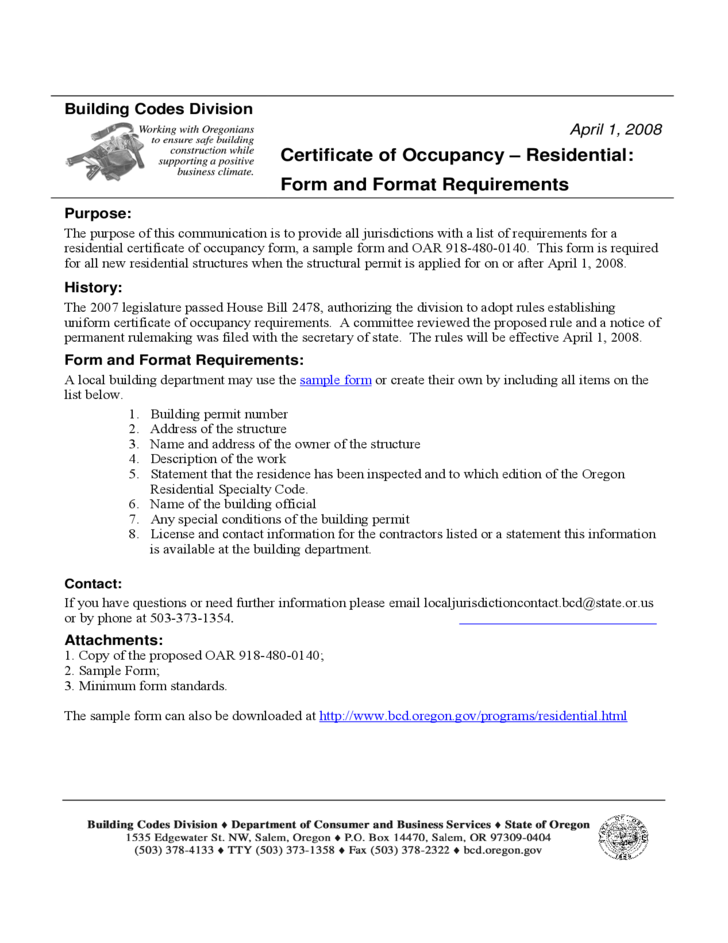
Buyers, lenders, landlords and contractors all ask the same question sooner or later: does this building have a valid certificate of occupancy? This page gives you 4 free certificate of occupancy template samples, all offered as PDF downloads, so you can see how a typical CO is laid out and which details usually appear on it. They are reference samples for study, training and layout ideas. An actual certificate of occupancy can only be issued by the local authority that inspects and approves the building.
What a Certificate of Occupancy Actually Confirms
A certificate of occupancy (often shortened to CO or C of O) is an official document issued by a city, county or other local building authority. It states that a building, or part of one, has passed the required inspections and may be used for its approved purpose. It usually names the address, the approved use, the occupancy classification, the issue date and the issuing office. It is not a guarantee of quality: it says the building met the applicable codes and approved plans when it was inspected. Names, rules and fees differ from place to place, and some areas use terms such as occupancy permit, certificate of use or certificate of completion.
When Someone Asks You for One
Real-world situations show why the document matters. A buyer’s lender may want to see the CO before funding a mortgage. A landlord who converts a garage into an apartment may be told that the new use needs an amended certificate. A restaurant owner taking over a former retail unit may have to prove that the space is approved for food service and a specific number of occupants. A builder finishing a new house often needs the certificate before the family can legally move in. Being able to recognize the parts of a CO makes these conversations much easier.
Fields You Will Usually Find on a Sample
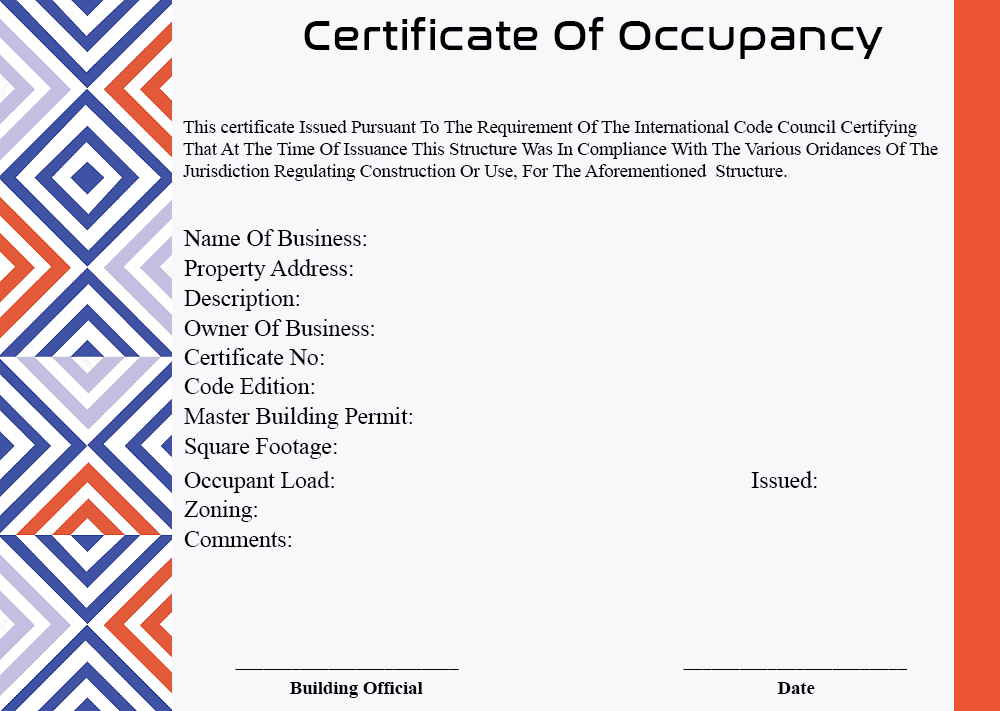
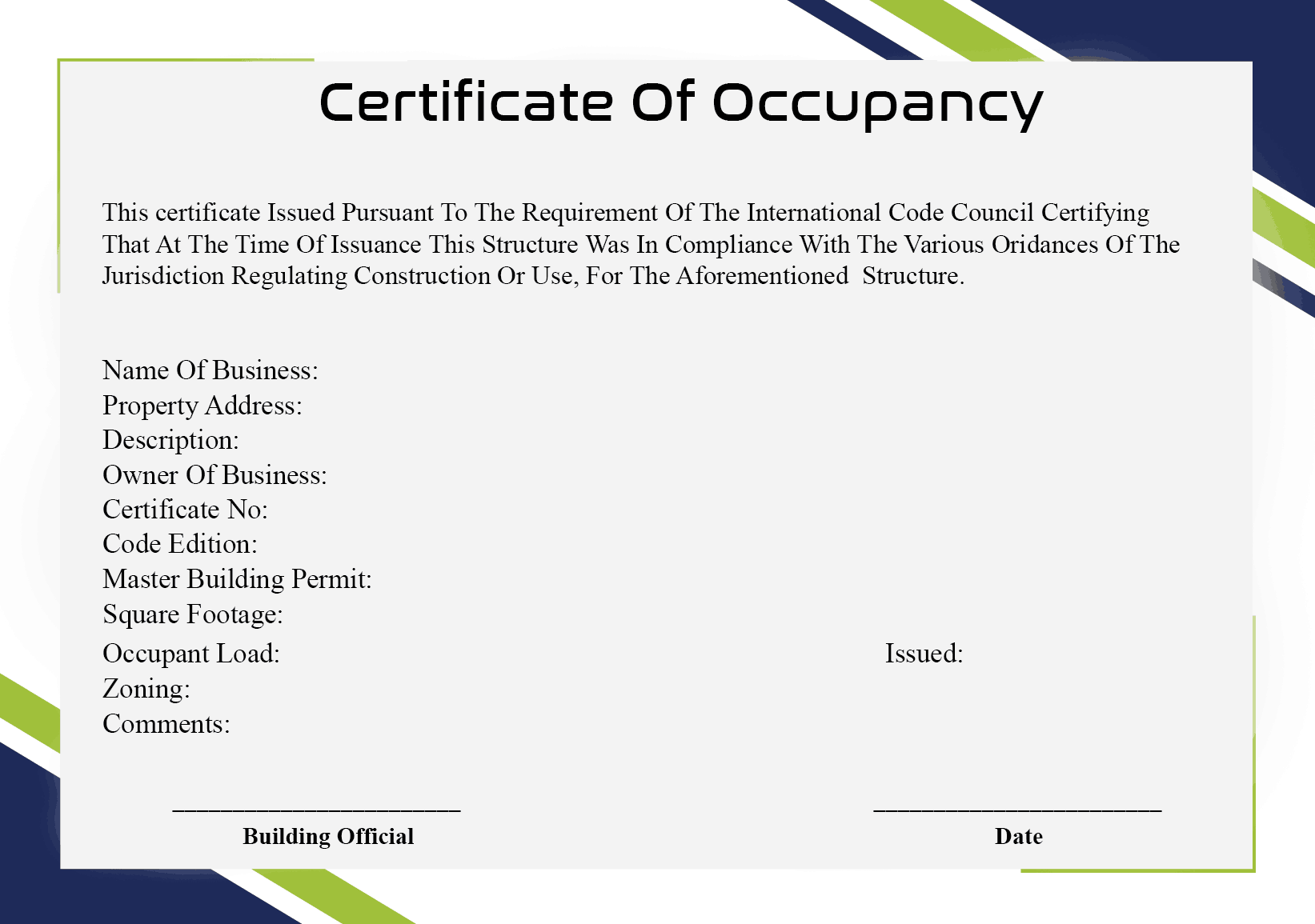
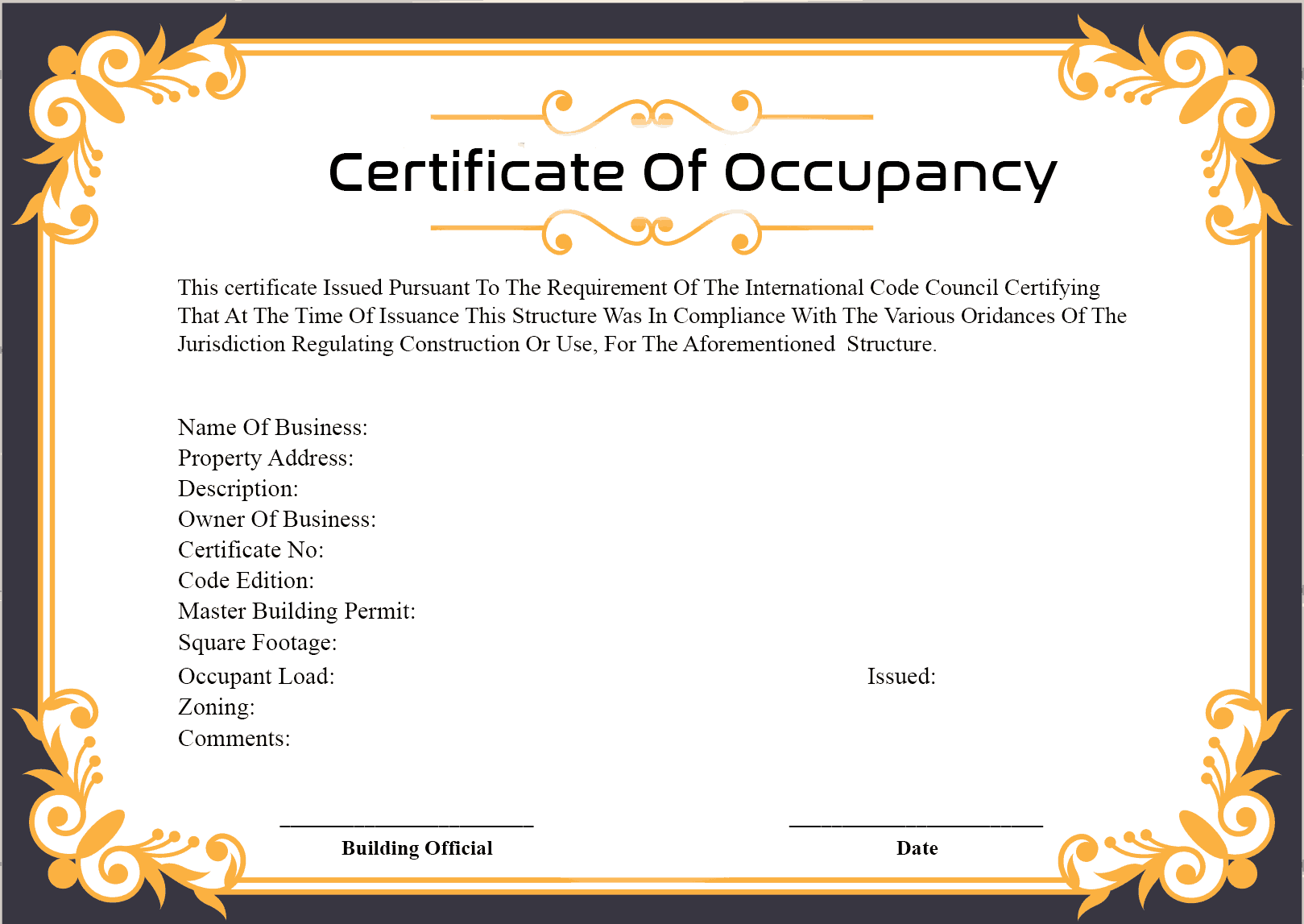
Use the samples below to compare layouts. Most of them include some or all of the following:
- The name and seal of the issuing department, and a certificate or permit number.
- The property address, and sometimes a parcel or lot number.
- The owner or applicant name.
- The approved use, such as single-family dwelling, office or retail, together with an occupancy class.
- Construction type and, for public spaces, a maximum occupant load.
- A statement that the building complies with the applicable codes and plans.
- Conditions or limits, which matter most on a temporary certificate.
- The issue date, an expiry date if temporary, and the signature of the building official.
Residential, Commercial, Temporary and Amended Certificates
- Residential: covers houses, apartments, condos and townhouses.
- Commercial: covers offices, shops, restaurants and warehouses, and usually lists the occupant load.
- Temporary (TCO): allows limited use while minor work is finished, and it expires.
- Final: issued when all inspections are passed and the work matches the approved plans.
- Amended: needed when the use or layout of an existing building changes.
The General Path to Getting a CO
The process varies, so contact your local building department for exact steps. In outline, the work is completed under the approved permits, the required final inspections (building, electrical, plumbing, mechanical, fire safety) are requested, any items the inspector flags are corrected and re-inspected, the paperwork and fees are submitted, and the authority then issues the certificate. Skipping a step, such as an unpermitted renovation, is the most common reason for delays.
Common Problems to Watch For
- A temporary certificate that has expired before the final inspection was scheduled.
- An address or use on the certificate that no longer matches how the property is actually used.
- Unpermitted additions or conversions that were never inspected and therefore are not covered by the original certificate.
- A lost original: ask the issuing office for a copy rather than recreating one.
A Quick Checklist for Reviewing Any CO
When someone hands you a certificate, read it against the property in front of you. Confirm that the street address is spelled exactly as on the deed or lease, that the approved use matches what the space is being used for today, that any occupant limit fits your plans for events or staffing, and that the issue date comes after the last major construction. If the document says temporary, note the expiry date in your calendar. If anything looks inconsistent, ask the building department to verify it. Many offices can confirm a certificate by its number, which is far safer than relying on a photocopy. Property managers and inspectors often keep a simple log of each building’s certificate number, issue date and any conditions, so renewals and expiry dates are never missed.
How to Use These PDF Samples Responsibly
Click a preview to view it at full size, then use the download button beside it to save the PDF. The PDFs are reference material, so use them to learn the layout, brief a team, build a training exercise or plan the information you need to collect. Do not present a sample as an official certificate or alter it to imitate a government document: only the responsible authority can issue a real one, and passing off a fake is illegal in most places. Keep the real certificate somewhere safe and store a scanned copy too.
Template file guide
Before using these reference samples
- Compare the address and permitted use with the document you are reviewing.
- Look for the issuing authority and any stated conditions.
- Obtain the actual certificate through the relevant authority.
Use the file links below to open an option directly, or continue to the previews to compare layouts. File formats are taken from the linked filenames. Extract ZIP archives before checking the files inside.
| File or resource | Format / source |
|---|---|
| certificate of occupancy sample PDF | |
| landscape certificate of occupancy PDF | |
| certificate of occupancy design sample PDF | |
| building certificate of occupancy PDF |
Certificate of Occupancy Template Samples

Related Templates
- free lease agreement templates for landlords and tenants
- rental agreement templates for residential or commercial lets
- salary certificate templates for another common proof document
- printable gift certificate templates for a different kind of certificate layout
Frequently Asked Questions (FAQs) About Certificates of Occupancy
What does a certificate of occupancy prove?
It shows that a building passed the required inspections and may be used for its approved purpose. Lenders, insurers, buyers and tenants often ask to see it.
Can I create my own certificate of occupancy?
No. Only the local building authority can issue one. These samples are for reference and training, not for issuing certificates.
How is a CO different from a building permit?
A building permit authorizes construction or renovation to start. The certificate comes at the end, after the work has been inspected.
What is a temporary certificate of occupancy?
It lets people use a building for a limited period while minor items are completed. It has an expiry date, after which a final certificate must be obtained.
When would an amended certificate be needed?
Typically when the use or layout of an existing building changes, for example turning a shop into a restaurant or adding a dwelling unit.
Which file format are these downloads?
The four downloads are PDF files. The previews can also be opened as larger images for a closer look.
Do I need a CO to sell or rent a property?
Requirements depend on local law. In many areas a valid certificate is expected before a property is occupied, sold or rented, so ask your building department or a qualified professional.
What should I do if my certificate is lost?
Contact the issuing building department and request a copy or replacement. Many offices keep records and can provide a duplicate.



You must be logged in to post a comment.